

What is Your 2 Cents Portland?
Your 2 Cents Portland (Y2CP) is an initiative petition and prospective ballot measure for the November 2026 election that would expand all Portlanders' voice in shaping their city budget through Citywide participatory budgeting, a proven democratic reform practiced by over 7,000 cities worldwide. Endorsed by over 50 organizations and dozens of community leaders Y2CP is a multiracial, city-wide movement, advancing a vision of a better Portland where every voice counts and every resident can exercise their power over City budget decisions that impact their lives.
Why the Your 2 Cents Portland Campaign?
City Hall works best when everyone's voice is heard and everyone can meaningfully participate. But too often entrenched interests and wealthy lobbyists drown out and overpower public voices for common good. That’s one reason why every Portlander should have a more direct voice and vote in the City Budget decisions. Your 2 Cents Portland gives all residents a direct say how to spend 2% of the city budget by finally bringing participatory budgeting (PB) to Portland. PB is practiced in over 7,000 municipalities worldwide, including dozens of large and small cities in the U.S. It is a proven mechanism for you and your neighbors to shape how Portland spends public money to make our neighborhoods stronger, our communities more resilient, and our city better. Because we all deserve a meaningful voice in how our city’s money is spent on our behalf.
Will it raise my taxes?
No. If a majority of Portlanders vote for Your 2 Cents PDX, the charter amendment would not raise any taxes. This measure allocates the equivalent of 2% of funds from the existing General Fund Discretionary budget. This includes existing revenue from property tax, business license taxes, lodging taxes. The City Council could also decide specific projects selected by residents could be funded with other existing taxes and fees that make up the entire City Budget. We all pay taxes but we don’t all get a voice and vote on how City funds are spent on our behalf. That’s why we need Your 2 Cents PDX.
What is participatory budgeting?
Participatory budgeting (PB) is a democratic process where residents of a municipality deliberate and directly decide how to spend a portion of a public budget. PB gives ordinary people real power over real public money. The process varies in implementation, but once funds are committed, the PB usually includes at least five basic steps:
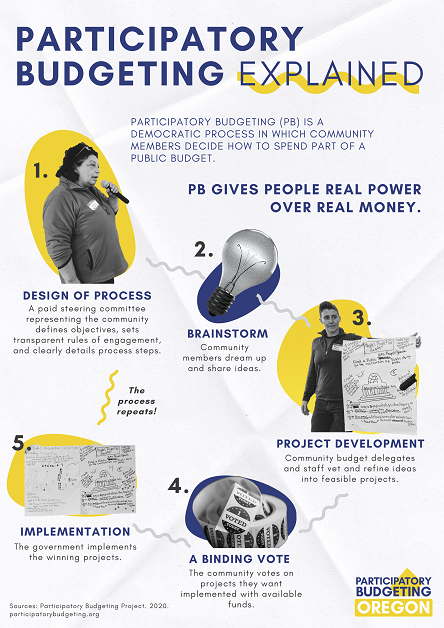
1) A representative steering committee designs the process rules.
2) Residents gather in assemblies or online to dream up and share ideas for potential projects.
3) Residents and public officials refine ideas into feasible
projects or programs the municipality can implement.
4) The residents vote to select projects to implement.
5) The city implements winning projects.
The highest impact PB processes are evaluated, improved, and repeated to expand the depth and breadth participation of a larger portion of the residents over time.
Practiced worldwide and across the United States PB simply gives people a voice and a vote over a portion of the public budgets that impact their lives.Can participatory budgeting really work? Is it proven?
 Yes. Participatory budgeting (PB) is a proven way to make city government work better, improve communities, and bring people together to solve our most pressing challenges, build trust and leadership, and expand the number and diversity of people meaningfully engaged in their government.PB began in Brazil in 1989 and has spread rapidly across the globe to major cities like Paris, Madrid, Mexico City, and Seoul. More than 7,000 municipalities on five continents and over 100 cities in the United States have already implemented participatory budgeting programs. In both larger cities like Chicago, Boston, and St. Louis, and Seattle and smaller ones like Durham, NC and Vallejo, CA residents routinely decide how to spend part of their city’s budget. A wide range of case studies and research indicate PB varies in design and impact but consistently increases the number and diversity of people participating, especially relative to traditional municipal budgeting where budgeting power is exercised or delegated entirely by elected bodies (Participatory Budgeting in Global Perspective, Wampler et al 2021).
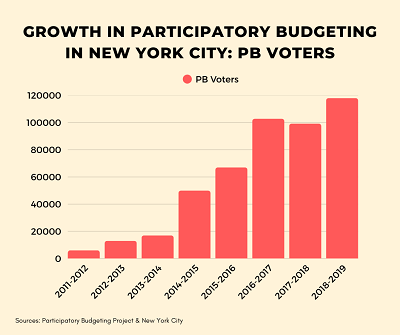
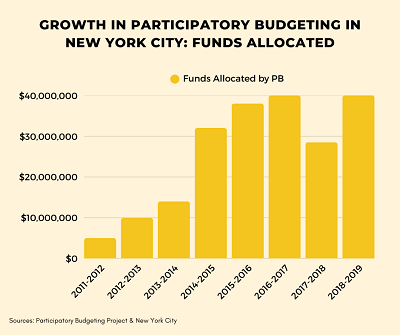 In New York City PB started in 2011 and has grown such that today thousands of New Yorkers allocate tens of millions of dollars annually through PB.
Here in the Portland-region, PB has had promising results. Metro is implementing a process for parks and natural area improvements and young people in East Portland who completed their own pilot 2024 using federal dollars.
PB is a proven mechanism of participatory democracy. It is time to bring Citywide PB to Portland, so all residents can have a direct say on public investments to improve livability, enhance public safety, provide housing and homelessness services, build neighborhood parks or any feasible City project or program that will improve their communities.
Where did Your 2 Cents Portland come from? How did we get here?
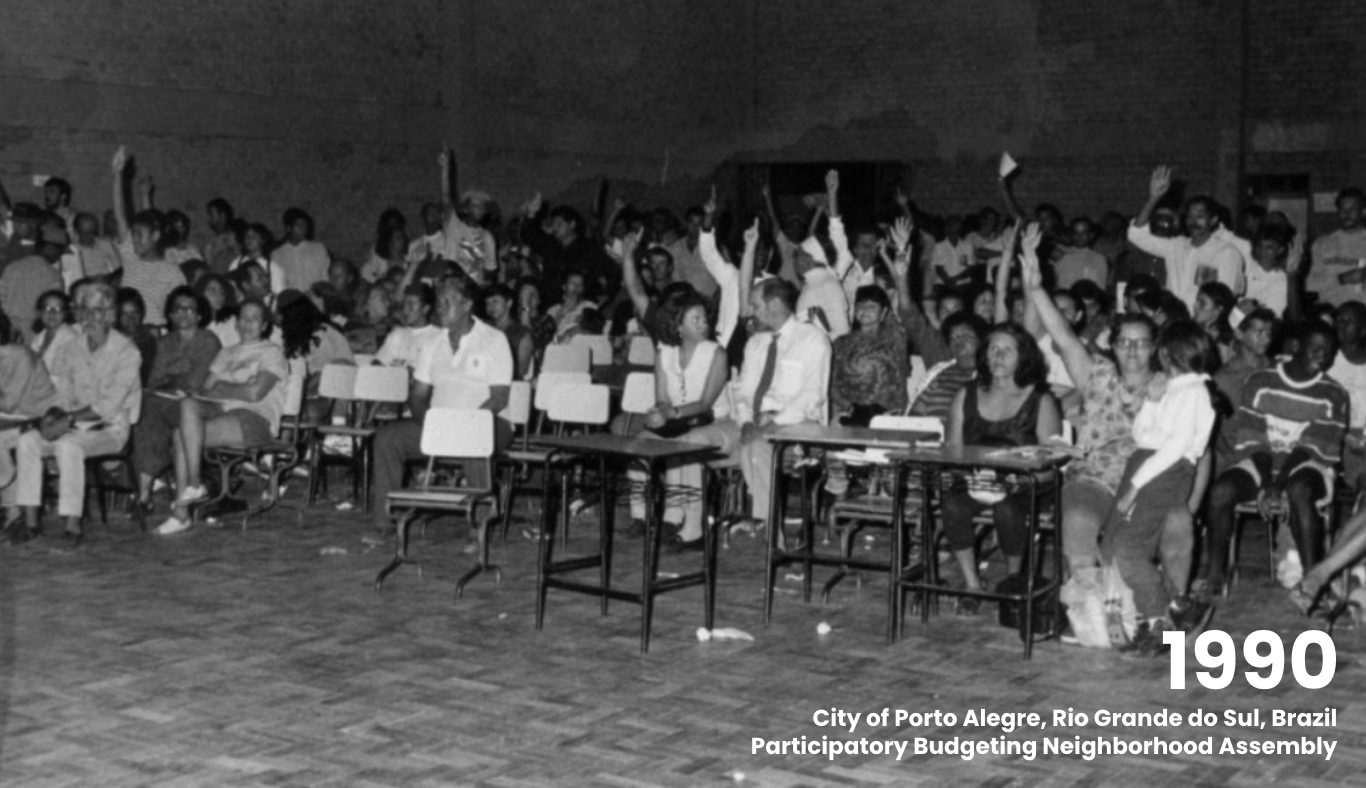
Participatory budgeting began in Brazil in the late 1980s in the City of Porto Allegre and rapidly spread across South America and then the world. Conservatively, PB is implemented in over 7,000 cities, towns, and villages around the globe, from Zimbabwe to Korea, from Paris to Mexico City.
Since the first process in Chicago in 2009, PB has spread across the United States. Major West coast cities including Los Angeles, San Francisco, Oakland, Tacoma, Seattle, and Vancouver and Victoria BC have all implemented municipal participatory budgeting processes in the last decade. However, Portland remains the only major city on the West Coast yet to do the same.
And not because Portlanders haven’t been asking for it. Portlanders have been advocating for PB since 2011 and both Metro and East Portland youth have implemented pilots. But the Portland City Council has failed to act. So, after years of community advocacy, Portlanders took their demands to the 2022 Portland Charter Commission and asked them to develop a charter amendment that could finally bring PB to Portland. The Charter Commission responded by crafting a PB amendment modeled after similar PB amendments adopted by 2/3rds of voters in New York in 2018 and in Boston in 2021. The Portland Charter Commission sent the amendment to the City Council in January 2023. However, once again, the City Council ignored the proposal and took no action to send it on to the voters.
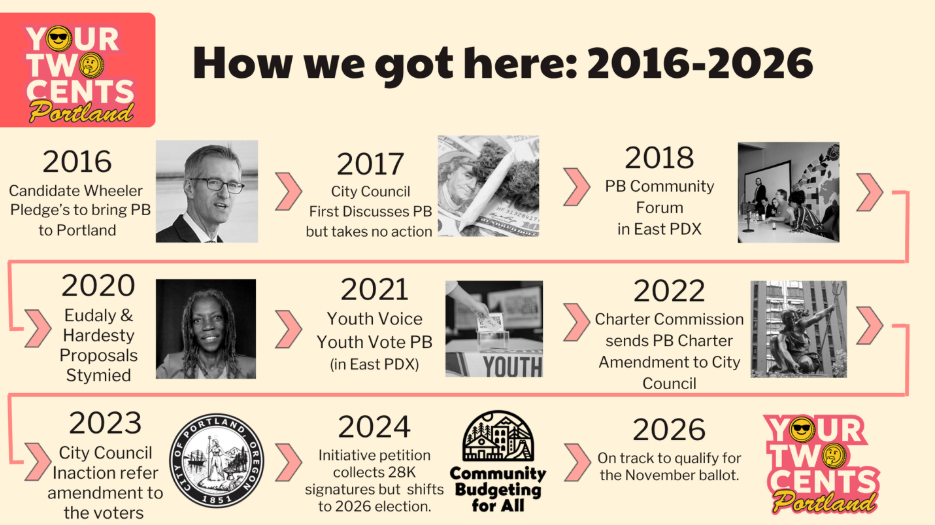 In response Next Up Action Fund and Participatory Budgeting Oregon launched the Your 2 Cents Portland campaign to put the charter amendment on the November 2026 ballot via initiative petition. It is long past due we had PB in Portland so that all residents can have a voice in their City budget!
Who supports Your 2 Cents PDX?
The Your 2 Cents PDX is co-led by Participatory Budgeting Oregon, Next Up, and East County Rising. Dozens of organizations including community groups, unions, small business, and coalitions support Your 2 Cents PDX. Endorsers include the Coalition for Communities of Color, AFSCME 1790, Multnomah County Democrats, Participatory Budgeting Project, More Equitable Democracy, American Association of Teachers Oregon, Imagine Black, Working Families Party, Urban League Unite Oregon, Democratic Socialists of America, and businesses like Andina Restaurant, Park Rose Coffee Shop, Splendid Cycles, and Orange Splot LLC, and Play Grow Learn LLC.
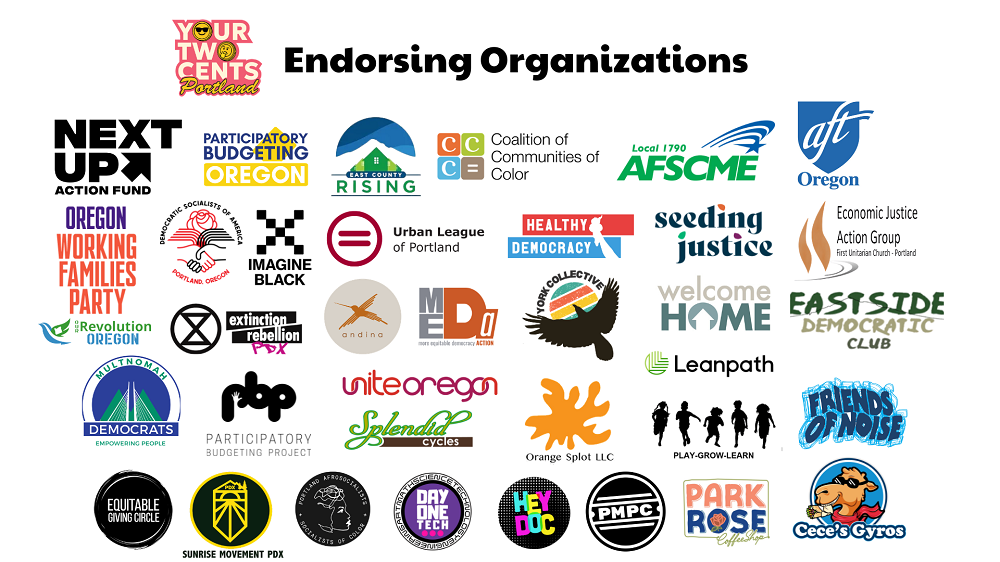
A variety of elected officials including City Councilors Avalos, Green, Morillo, Koyama-Lane, Kanal, and Dunphy; A number of Portland legislators like Ricki Ruiz, Andrea Valderrama, and other community leaders also support the measure.
Has participatory budgeting been piloted in the Portland-Region?
Yes, twice! In Portland Metro voters adopted “participatory grant-making” as part of the 2019 Regional Parks & Nature Bond Measure. In 2023 Metro piloted a process of community driven project-selection using participatory budgeting principles and voting to select projects implemented under its Community Choice Grants Program.
In 2021 State Legislatures allocated $620K in American Rescue Plan ACt Funds for Oregon’s first participatory budgeting (PB) process, Youth Voice Youth Vote PB (YV2PB), implemented by and for youth in the East Metro region, including East Portland.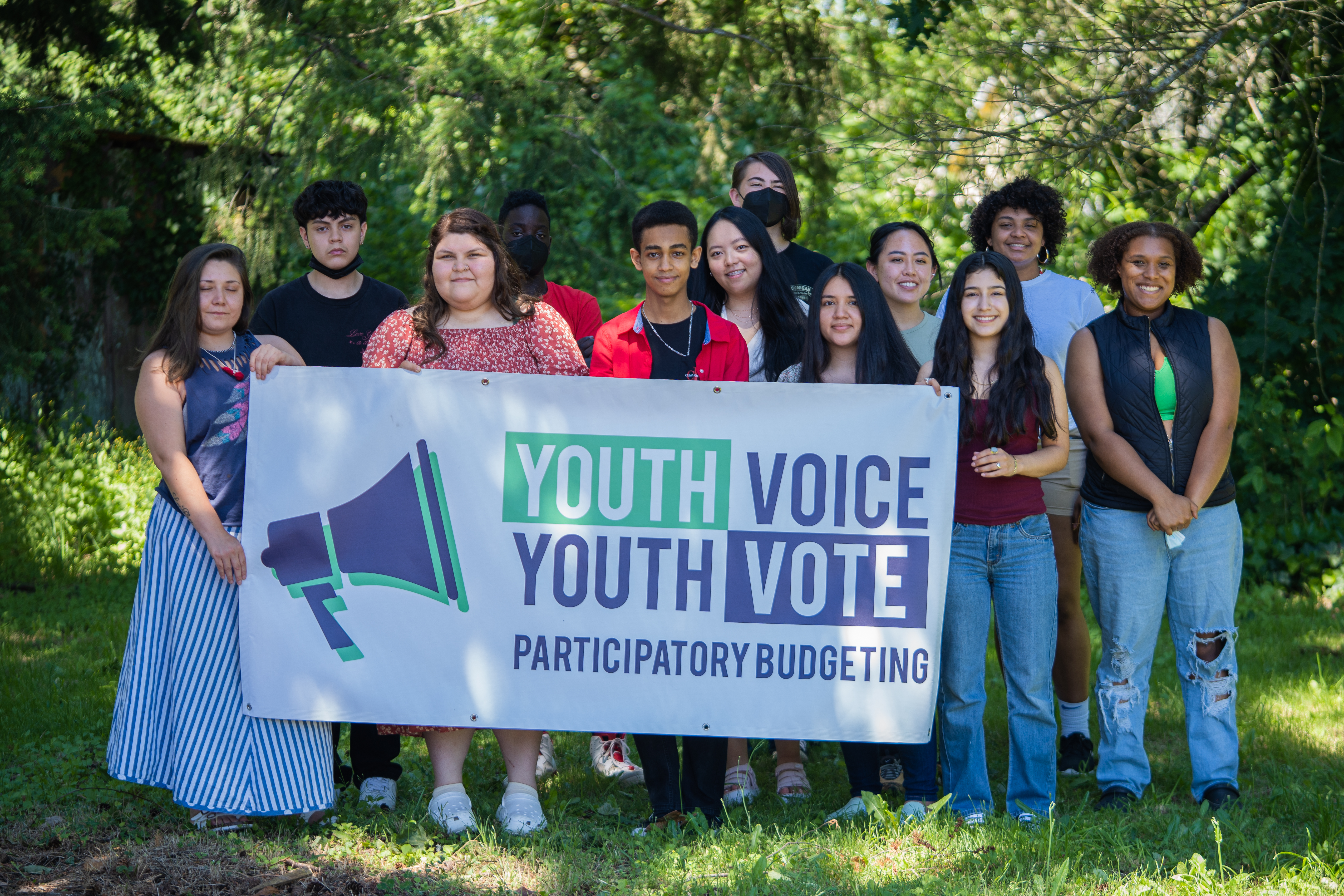 YV2PB youth became leading advocates for a PB in the Portland Charter Commission’s Phase II which produced the first draft of the charter amendment that became Your 2 Cents PDX. Portlanders understand that PB is a proven method of delivering the real voice and real vote they want in their City budget. Your 2 Cents PDX builds on the best practices elsewhere to launch and adapt transformative PB for Portland.
What will Your 2 Cents Portland do if adopted by voters?
If passed by voters, the Your 2 Cents charter amendment would require the City Council to establish, by ordinance, a participatory budgeting (PB) process. However, in addition mandating the City to do PB on an annual and biannual basis, the charter amendment requires the program include the following parameters and provisions:
- The PB process must be open and accessible to all residents including young people and other residents who can’t vote in elections.
- Allow for both Citywide and District-level projects and project selection.
- An idea collection phase to solicit project ideas from all residents through a variety of mechanisms.
- A project development phase where residents and City staff work together to refine ideas into feasible projects the City can implement and prepare a ballot.
- A project selection phase in which all residents vote to select winning projects.
- Binding decisions by residents determine the projects the City implements.
- PB Oversight Committee with representatives from every City Council District provides oversight and guidance to City staff for process design, implementation, and evaluation. At the outset of each PB cycle, the Oversight Committee will also help staff craft the PB Rule Book to provide clear process rules (see this example Rule Book from Boston).
- Funding begins FY27-28 fiscal year, and the first PB cycle must start by July 2028.
- Program evaluation and improvement, with a focus on maximizing participation of all residents in all phases of the process.
- Periodic program audit by the City Auditor
Beyond these required elements, the City Council has flexibility in crafting the PB program ordinance. This will include deciding what City department. Likely candidates might include Civic Life or Portland Solutions. The City Administer, PB Oversight Committee and hired City staff will also play a critical role in ensuring process design and implementation maximizes equitable participation and outcomes over time, as required by the charter amendment. For more information see the Y2CP Policy Factsheet.
How will the PB Oversight Committee be selected? What power will they have?
Under the proposed charter amendment, the Participatory Budgeting (PB) Oversight Committee shall include, “residents representing all City Council districts [and] shall be selected by a process determined by the City Council.” Thus the PB Oversight Committee composition will be determined by the City Council and probably will be initially appointed directly by the City Council to represent each of four City Council Districts. However, the charter amendment provides flexibility to innovate and could allow selection by democratic lottery to guarantee representation across Portland’s diverse communities.
The PB Oversight Committee’s will be responsible for helping City Staff design an PB process that maximizes equitable access to all Portlands and review and evaluate each cycle to “improve desired impacts and outcomes and to increase participation of all residents in all phases of the process.” One thing the PB Oversight Committee won’t do: decide how the money is spent. The charter amendment notes it “will not make decisions about how funds allocated through the Participatory Budgeting process are spent.” In PB and in this charter amendment that power is clearly delegated to all Portlanders through a “binding selection process open and accessible to all residents” once the PB qualified projects are identified for a ballot.
How will PB qualified projects be identified for the ballot?
The details of developing feasible projects for the PB ballot will be refined in the implementing ordinance, but the Your 2 Cents Portland Charter amendment clearly states that this process must be transparent and include both residents, selected as representative budget delegates, and City staff. This guarantees that PB qualified projects will include both the local knowledge and lived expertise of residents and the technical knowledge of City staff to ensure they are feasible. This failure of most public works projects stem from this lack of transparency and responsiveness directly to the residents that are meant to benefit. It is why winning PB projects in NYC are implemented with fewer complaints than traditional public work projects.
Who will administer the voting to select PB Projects?
The voting phase of PB and the Your 2 Cents Portland Charter Amendment is a crucial step where in residence exercises budgeting power. And a critical aspect of this vote is that it is open to all residents, including the young Portlanders and new Portlanders in immigrants and refugees who cannot vote in City elections. Under Your 2 Cents Portland roughly 150K Portlanders (over 1/5th of residents) will be able to participate as equals in the process. Because the PB vote must include all residents, it will not be administrated by the Portland Elections office but by another City Bureau who can ensure all residents get a say. This is how PB is implemented in New York City and Boston and every municipality with PB in the United States.
Can we afford this now? Isn’t there a tight City budget?
Some public officials claim that the City can’t afford to give residents more voice and vote over (our two cents) of our city budget. But here is the thing, Your 2 Cent doesn’t change the amount of available money, it just changes who decides. While residents may decide to spend City resources differently than the City Council has in recent years, that is the entire point of participatory budgeting: to give residents more voice and vote over their budget.
Portlanders want more say over their budget and Your 2 Cents PDX delivers exactly that. Your 2 Cents would allocate the equivalent of 2% of General Fund Discretionary resources, or roughly $16 million per year, through participatory budgeting open and accessible to all residents. That is actually 3/10ths of 1% of the entire $6.5 billion budget. The City can definitely afford to give residents more voice and vote over their City Budget. Austerity is not an argument for continuing to limit their voice but in fact a reason to give them more voice. Finally it should be pointed out that the General Fund is actually forecast to run a surplus starting in FY28-29 just the first PB cycle would begin under Your 2 Cents Portland.
Public trust is at an all time low right now. Most Portlanders doubt public resources are being well spent and there is regular evidence the City could spend public funds better. So, the real question is really whether we can not afford to give residents a more direct voice in their budget, in public investments being made on their behalf?
Does participatory budgeting allocate funds to one-time projects or ongoing programs?
Participatory budgeting allocates funds to one-time projects or limited duration services or programs. It does not fund ongoing City programs. However, PB often generates new innovative ideas that become established, annually funded programs. For example, a winning project ‘‘’People Not Police’ Crisis Response Team” ($2 million) in Seattle’s 2023 PB process has since become an ongoing General Fund expense. In New York City several one-time youth mental health workshops and small business support programs proved so popular that they have been folded into the City’s permanent annual citywide budget.
We just reformed the structure of government and the kinks are still getting worked. Is this the right time to start a new City program?
The City implemented an entire government reform of the City’s structure of representative democracy in 18 months following voter approved charter reforms in 2022. It can absolutely implement one program innovating our structure of participatory democracy in 18 months. In fact, in 2023, City Administrator Michael Jordan who co-led the Government Transition process in 2022-2024 noted that, given everything is in flux, this is actually the ideal time to integrate something like participatory budgeting into the new form of government.
The 2022 Charter Commission sent its original PB Charter Amendment to the City Council in 2023 knowing this was doable. The City of Boston had recently implemented its voter-approved charter-mandated PB in the same timeframe. And as a late-adopter, Portland is definitely not re-inventing the wheel. There are well over 7,000 municipalities implementing PB, some in the United States like New York, Boston, and Chicago that have done so for over a decade. Finally we have expertise here in our region with recent pilots, the Youth Voice Youth Vote PB process in East Portland and by Metro’s Nature in Neighborhoods Community Choice Grants Program.
Portland’s new system of representative democracy made our City Council much more representative and it consolidated City administration under the mayor. But reforming Portland’s participatory democracy is the unfinished work of charter reform.
Will participatory budgeting be dominated by the usual suspects?
No. The record of PB around the world suggests the opposite and Your 2 Cents applies key provisions to maximize equitable participation and outcomes.
Democracy is not just who shows up; it's who can show up. By giving more residents more voice and vote in budgeting, PB makes it easier for all people to show up in the budgeting process. It is a proven reform for making the budgeting process more accessible to a greater number and a greater diversity of residents.
Very few people can show in the traditional budgeting process. It is highly dominated by the wealthy, influential and connected who can lobby the hardest (or yell the loudest) at City Budget hearings. That’s why debates over PB where it has been implemented are most often about how to make the process more inclusive and accessible, not whether it isn’t already a vast improvement over the traditional budgeting process. It is easy to improve on the status quo.
By giving more residents more voice and vote in budgeting, PB is a proven reform for making the budgeting process more accessible to a greater number and a greater diversity of residents. After all, the status quo budgeting process is highly dominated by the wealthy, influential and connected who can lobby the hardest (or yell the loudest) at City Budget hearings. That’s why debates over PB where it has been implemented are most often about how to make the process more inclusive and accessible, not whether it isn’t already a vast improvement over the traditional budgeting process. It is easy to improve on the status quo.
PB practitioners around the world have researched PB impacts and benefits and the features and practices of the most inclusive and equitable PB processes. In general, allocating larger amounts of funds consistently over longer periods of time have been shown to benefit low-income populations. For example, in Brazil research indicates cities that implement PB spend more on public health and on other priorities that tend to benefit low-income residents. In New York City, these best practices and a focus on equity have helped to grow participation and discouraged domination by well-organized groups. New Yorkers collectively budgeted differently than their elected officials; for example, they chose to spend more on schools, public housing, and streets and traffic improvements (See sources for all of the above here).
Evaluations of PB in New York have found people of color, low-income, youth and women voters were either overrepresented or represented proportionally relative to the local census and that approximately 1 in 5 voters cast a ballot in a non-English language. A 2015-16 evaluation PB Greensboro, NC found participants age, race, and income generally reflected that of the City’s population. The need and opportunity to address racial justice, is in part why the both Movement for Black Lives Policy Platform and the Oregon Commission on Black Affairs have both endorsed PB implementation on the local level.

Proven best practices and innovative design features means PB can yield dramatically more equitable participation, outcomes, and public investments that are far more responsive to communities' needs. And as a late adopter, Portland is ideally positioned to apply these best practices from the over 7000 municipalities around the world who have implemented PB, in many cases for decades. In the United States cities like Boston, New York, Chicago and Seattle have many lessons we can learn from in optimizing and adapting PB to Portland.
There are several reasons the Your 2 Cents charter amendment would position the City to learn from PB elsewhere and maximize equitable participation and outcomes through multi-racial, multi-generational PB process accessible to all.
Permanency of Charter mandated PB: Charter-mandated PB will ensure Portland implements multiple cycles in perpetuity which is critical to increasing the number and diversity of people participating overtime. In Paris where almost 10% of the population now participates, PB has been charter-mandated and implemented annually since 2014.
Charter Mandated PB “Open All Residents”: The proposed Charter Amendment requires the City to implement PB “open to all” residents. Thus, it must explicitly include young people and non-citizens who can’t vote in elections and therefore have the most to gain from charter-mandated PB. As noted above this would amount to including 150,000 to 180,000 residents in the PB process that can’t currently vote in elections.
Amount of funds allocated: The higher the amount of funds allocated through PB the more diverse participation and the more spillover effects that shape elected officials in the traditional budgeting process. The proposed Portland charter amendment requires a minimum allocation to ensure at least $1 to $2 million per 100,000 with each cycle, more than the minimum best practice for inclusive PB. Under the proposal, the City Council will be able to allocate more funds through PB in high-need City Council Districts to help increase equitable participation and outcomes.
Mandated Evaluation: The proposed PB Charter amendment would require both the City staff and the Auditor evaluate the program with the explicit goal of maximizing the participation of all Portlanders over time.
Portland’s Civil Society Networks: A 2021 book Participatory Budgeting in Global Perspective, leading PB researchers examined hundreds of case studies around the world and concluded that dense civil society networks and organizations (like those found in Portland) were both a cause and an effect of high impact participatory budgeting. Research on successful PB implementation in Bologna, Italy also found that existing social networks and participatory structures amplify the impacts and benefits of PB.
How much will it cost to implement the participatory budgeting process?
Based on best practices in other cities, the cost of implementing the PB process itself will cost around $1 million per year or 1/16th of the program funding. The charter amendment authorizes the use of program funding to “cover staffing and initial and ongoing PB process implementation and evaluation.” These funds will principally be used for process design, outreach, education, idea collection, development of feasible projects, ballot creation and voting, and evaluation.
Why 2% or roughly $16 million starting in FY27-28? Why not more? How does this compare with other Cities implementing PB?
The Y2CP charter amendment funds the program with a minimum equivalent of 2% of the General Fund Discretionary Resources but allows the City to meet this obligation from the entire $6.5 billion City Budget. This would allocate roughly $16 million or $20 per capita starting in FY27-28 and this amount grows with the size of the General Fund which generally tracks population growth.
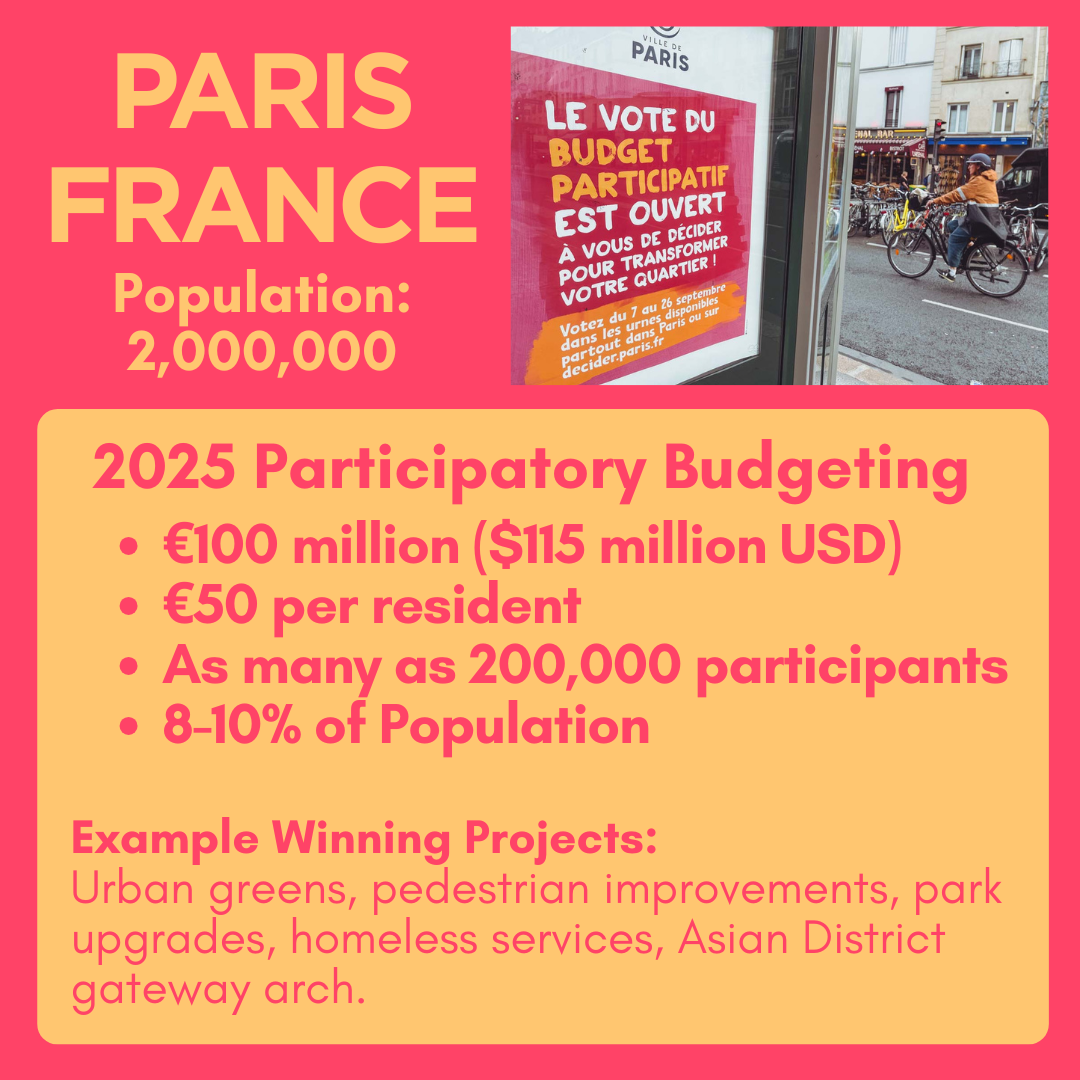
Y2CP would establish one of the largest or the largest per-capita PB processes in the United States but this, by itself, is less significant than it sounds because per-capita PB programs in the United States tend to be low by international standards. For example, Paris now engages about 10% of its population in allocating roughly 50 euros per capita per year.
The Y2CP was developed from researching best practices to maximize equitable participation and outcomes. Specifically:
Municipalities that allocated more money per capita through PB have seen greater community participation (People Powered 2025).
Research in Brazil also indicates PB produces more equitable outcomes when it includes redistributive design features (Touchton & Wampler, 2020).
New York voters adopted charter mandated PB in 2018 and Boston voters followed in 2021. Neither of these charter amendments allocated a minimum percentage of the budget and this is recognized as a major weakness by advocates because it led to a PB process with limited amounts of funds, roughly $6 per capita in Boston and less than $ 1 per capita in New York City, although NYC allocates upwards to $30 million annually through District level PB which increases this number roughly $8 per capita.
Paris also established PB by charter-mandate in 2014. Today over 10% of the Parisians (~200,000 residents) annually allocate 100 million euros to projects in their City through PB. Paris also earmarks roughly 30% of these funds specifically for working-class and lower-income neighborhoods.
Best practice indicates a PB process, at minimum, requires at least $1,000,000 per 100,000 residents (10 per capita) to meaningfully engage a population (Urban Institute 2022).
Based in this research and experience elsewhere, the Your 2 Cents PDX policy would funds PB at about twice this minimum best practice in order to:
(1) meet minimum best practice Citywide,
(2) provide more than the minimum per-capita best practice allocation in City Council Districts 1 & 2 so there is a greater stake for residents in these under-resourced areas of the City, and
(3) provide sufficient funding to design and implement a PB process that applies best practices (robust communications, training for culturally specific communities, paid budget delegates) known to help maximize equitable participation and outcomes.Based on what we know, Your 2 Cents provides sufficient minimum funding to successfully establish meaningful PB in Portland. The funding will grow in proportion to the City’s population as the General Fund grows and can expand beyond that to increase transparency, accountability and participation over additional public funds over time if Portlanders desire.
What are some of the other impacts and benefits of PB?
Participatory budgeting is one of the fastest growing and widest researched mechanisms of participatory democracy in the world. Research around the world documents the short-term outcomes and long-term impacts of participatory budgeting (PB) on people, communities, and governments. Some examples include:
- Stronger Communities: Studies have found that participation in PB processes promotes tolerance, an orientation towards the common good, and a disposition to solve conflicts. (Schugurensky, 2006; Gregorčič & Krašovec, 2017)
- Increased Civic Engagement: Research has found that PB participants report increased interest in voting and participating in civic and community life (Jovanovic et al., 2016).
- Increased Voting: In both NYC and Prague studies demonstrate that PB increases electoral voting (Johnson et al., 2021; Kukučková, S., & Bakoš, E. 2019).
- More Equitable Outcomes: In Brazil, municipalities using PB programs have lower infant mortality than comparable municipalities without PB. The effect grows stronger after more than eight years of PB (Gonçalves, 2014; Touchton and Wampler, 2014).
- Broader & More Diverse Participation: A number of studies show that specific PB design features increase the number and diversity of PB participants and narrow the civic engagement gap between the general public and marginal groups. Design parameters to increase the participation include the amount of funds allocated, degree of outreach and education to culturally specific groups, more expressive voting systems, and more meaningful control over decision-making outcomes (People Powered, 2025).
- More Responsive Government Services: In NYC PB has been linked to improved public service performance as measured by a significant reduction in complaints associated with public works projects (Sihotang 2023).
Shouldn’t the City Council make all the decisions about how the City’s money is spent?
The City Council DOES NOT decide how all funds are spent. In adopting a City budget the City Council regularly delegates that authority to unelected public officials or political appointments or even to Bureau Staff and Grant Review committees who then decide exactly how public funds are spent. All Your 2 Cents PDX does is make sure all Portlanders also get a say. It delegates some budgeting power directly to the residents who are supposed to directly benefit from budget decisions.
The people should be the ultimate sovereign power in a democracy. Participatory budgeting grounds decision making power over a portion of the budget for all the residents who pay City taxes and fees. This includes the 150,000 Portlanders who can’t vote in elections and are not formally represented on the City Council.
What are some examples of winning projects from other Cities that are implementing participatory budgeting?
There are thousands of examples of winning participatory budgeting projects across the United States and around the world. Most PB in the United States allocates capital improvement funds to build physical infrastructure. Examples include pedestrian safety projects at street intersections, play grounds and other park & trail improvements, street repairs, and public restrooms, but also community gardens, tree plantings, or other green infrastructure improvements. A winning PB project in Rochester NY funded affordable tiny homes for the unhoused. Increasingly PB is allocating discretionary expense funds that can be used for limited duration programs or services. Examples include a youth firefighter emergency service academy in Vallejo, CA;, a homeless services crisis response team in Seattle; violence reduction programs in Grand Rapids, MI; and programming at a Youth LGBTQ+ center in Durham, NC. Check out some example winning PB projects from around the U.S. and the globe.
What are some examples of PB processes outside the United States?
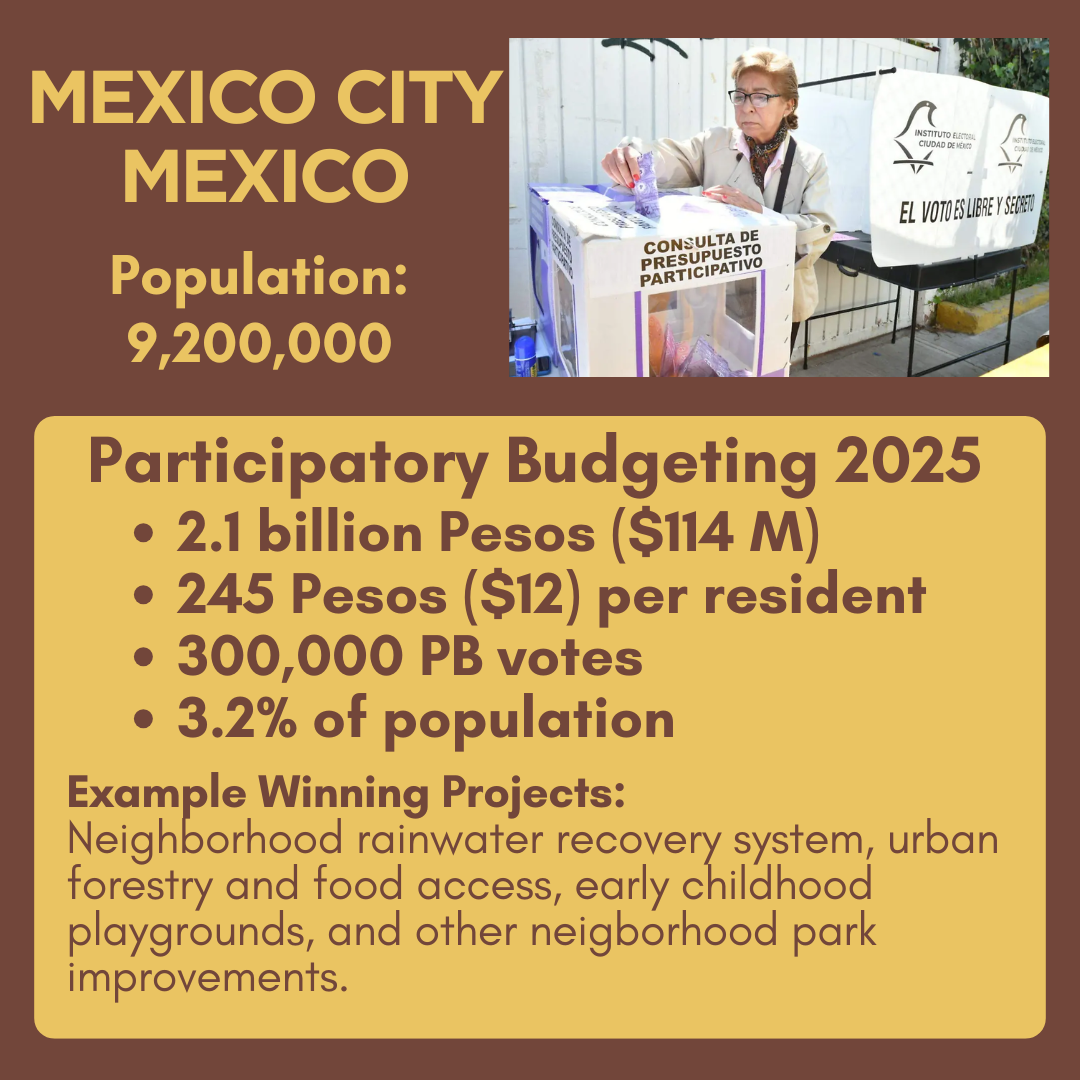
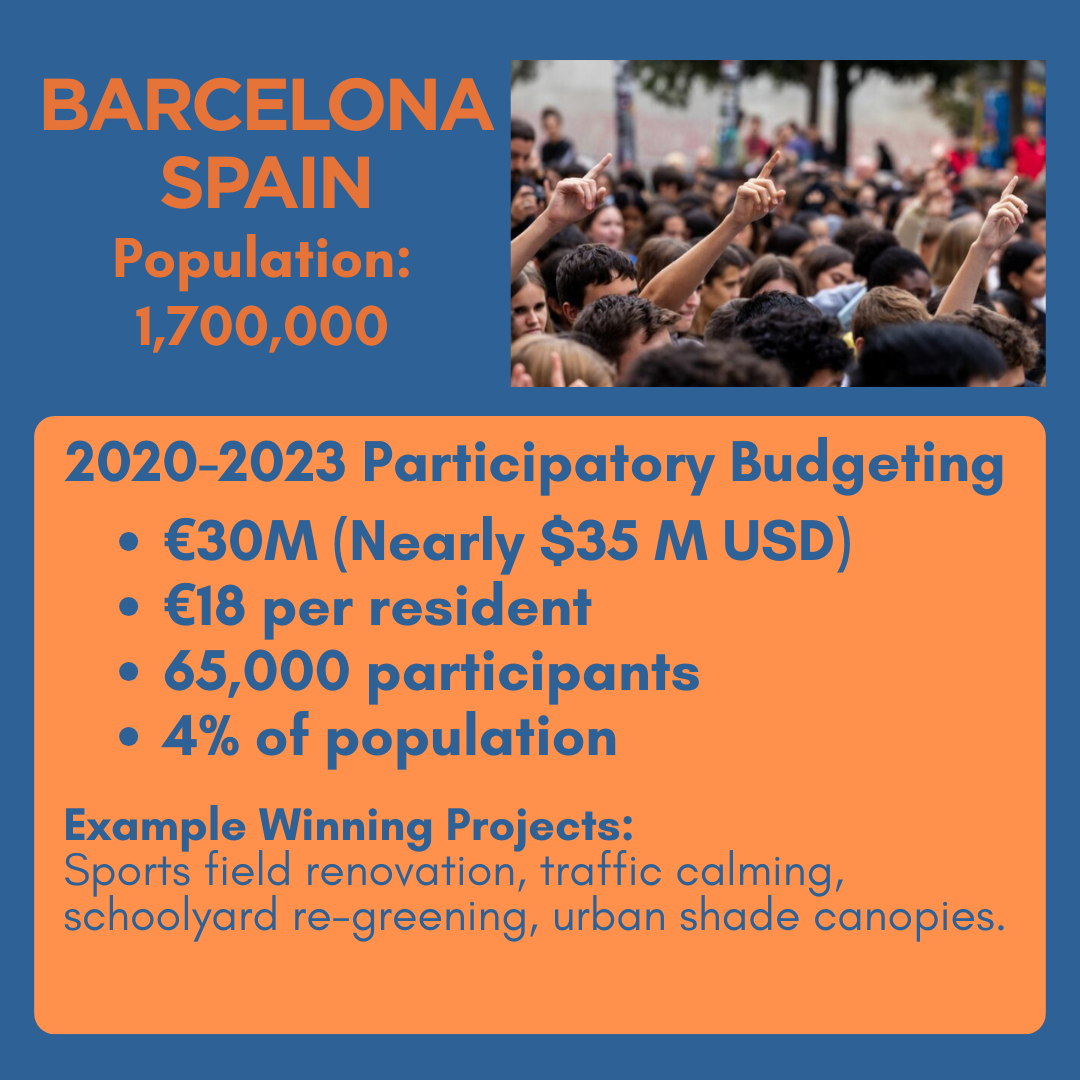
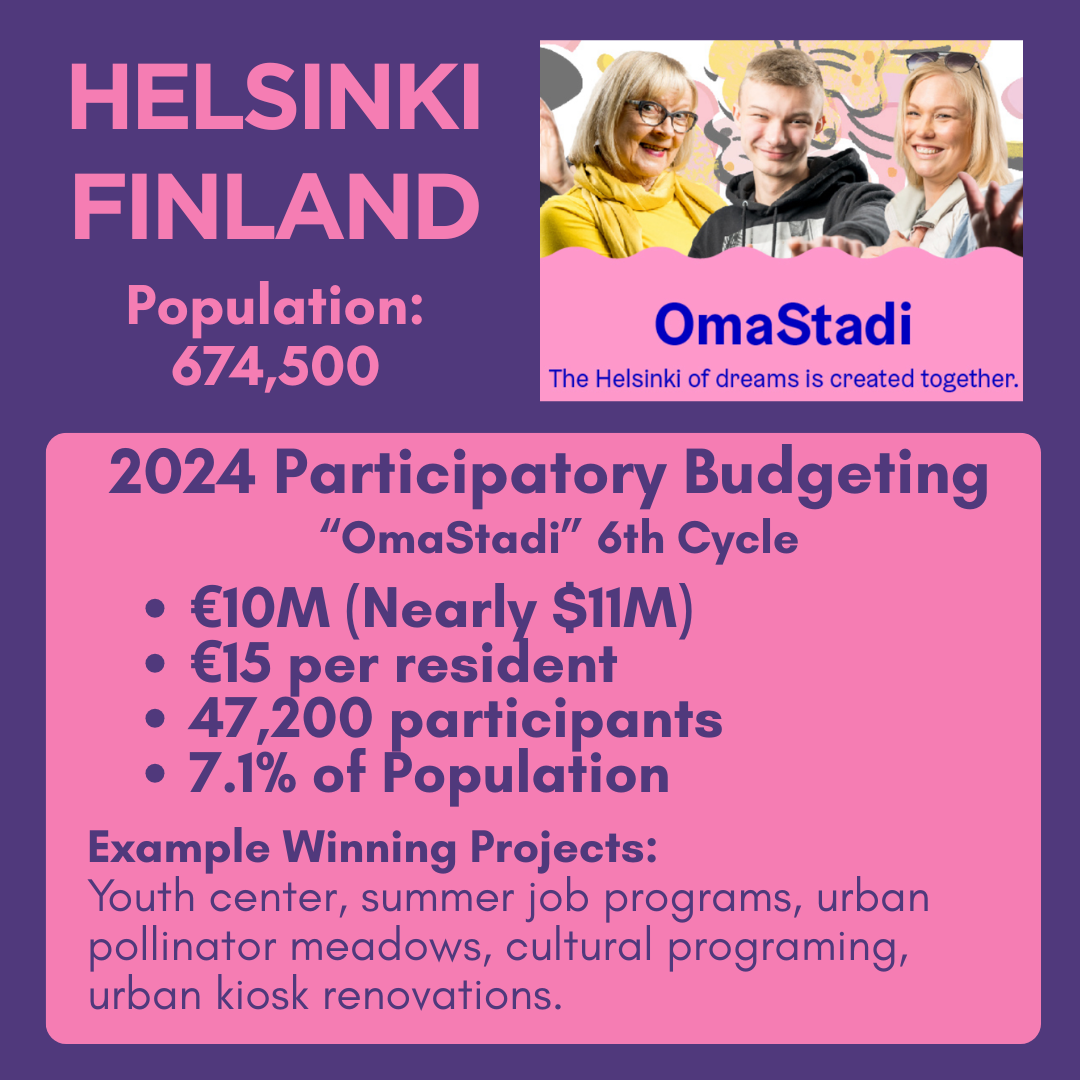
Most municipal participatory budgeting (PB) in the U.S. has allocated relatively small amounts of money and reaches relatively few people. But many across major cities in Mexico, Canada, Europe, Asia, South America and Africa have moved toward allocating much larger amounts through PB (see images).
These programs around the globe demonstrate that the more funds allocated, the more people participate. That’s one reason why Your 2 Cents PDX proposes to allocate at least $16 million annually ($20 per capita) starting in FY2028-2029, and will grow with the population over time.
With Your 2 Cents PDX Portlanders have a chance to go big,,to reach the level of mass participation developing in many major cities around the globe, from Paris to Mexico City and beyond.

How can you help?
- You can help collect signatures! Request a signature gathering packet by emailing your request and your mailing address at info@your2centspdx.com.
- You can also volunteer in other ways such as tabling at events, hosting a house party, or helping an organization endorse the campaign.
Donate to the campaign! Every donation helps to build our movement and win in November 2026.