
Case Study: Participatory Budgeting in New York City
When governments allocate enough public money through participatory budgeting (PB), let residents decide, and then follow-through in implementing their decisions, people take note and participation levels in subsequent PB cycles tend to grow rapidly. That is one of the lessons from PB in Brazil in the 1990s. It is also evident in the growth of PB in New York City (NYC) since 2011. NYC also illustrates the benefits of PB for broadening participation beyond the usual suspects, motivating marginal voters to vote in elections, and improving government service delivery.
Growth of PB in NYC
The first cycle of PB in NYC began in 2011 with four City Council districts. The process resulted in roughly 6,000 people voting to allocate some $5 million to fund 29 capital improvement projects. The following year some 13,000 participated in allocating $10 million for 45 capital projects and PB expanded to eight City Council districts. By the 9th cycle beginning in 2018 roughly 118,000 New Yorkers allocated $40,000,000 in projects across 32 of 51 City Council Districts. PB implementation suffered but did not end with COVID 19 between 2020-2021 but growth has continued.
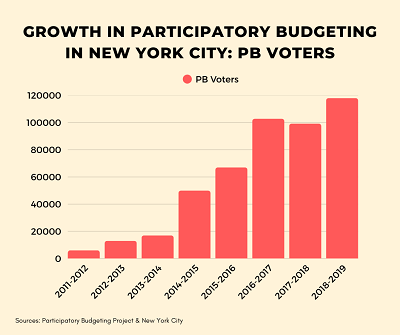
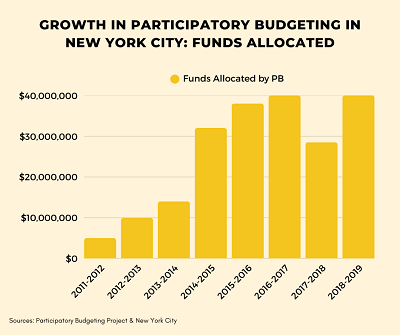
Charter Mandated PB
New Yorker voters seeded that rebound in 2018 when they overwhelmingly adopted (>66%) a charter amendment mandating Citywide PB in NYC. Called the People’s Money, the program began by allocating $1 million in discretionary funds in 2022 which has averaged over $4 million since. These funds are entirely discretionary and extend the PB across all five Boroughs. Unlike the capital dollars used in New York’s many District-level PB processes, the discretionary funds allow residents to propose and select a much wider array of duration-limited programs or services. New Yorkers responded. In 2023, the People’s Money program drew out almost 140,000 alone to cast votes for winning projects. That’s on top of the over 76,000 New Yorkers who participated in District-level PB.
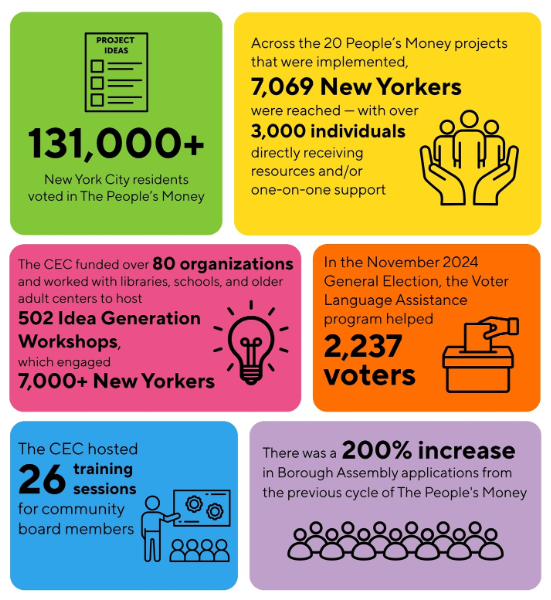
Research has documented a range of positive impacts from over a decade of PB implementation in New York. As seen elsewhere, research & assessments of PB in New York draws a greater diversity of participants than the population or electorate For example, in Cycle 4 of PB in NYC, 27% of PB voters compared to 8% of local voters were residents with low income. 57% of PB voters were residents of color compared to 47% of local voters. NYC PB has also led to more responsive government services and less contentious project implementation. Another NYC study documented the likelihood of eligible voters casting ballots in subsequent City Council elections increased by 8.4 percentage points after participating in PB.
New York PB by the Numbers
Launched: 2011 Last Cycle of Implementation: 2025 Estimated Total Funds Allocated 2011-2025: $311 million Estimated Number of PB Votes to date: 1.3 million
Sources:
Participatory Budgeting in New York City, Rule Book 2012-2013. Online at https://www.participatorybudgeting.org/wp-content/uploads/2012/07/Rulebook.pdf
Participatory Budgeting in New York City, Rule Book 2013-2014. Online at https://www.participatorybudgeting.org/wp-content/uploads/2012/07/PBNYC-2013-2014-Rulebook-easy-print-version.pdf
Participatory Budgeting in New York City, Rule Book 2019. Online at https://www.peoplepowered.org/resources-content/pb-new-york-city-cycle-9-rulebook
Kasdan, A., & Markman, E. (2015). A people’s budget: Cycle 4: Key research findings. New York, NY: Urban Center Community Development Project.
Public Agenda, A Process of Growth: The Expansion of Participatory Budgeting in the United States and Canada in 2015-2016. A Public Agenda report by Carolin Hagelskamp, Chloe Rinehart, Rebecca Silliman and David Schleifer and in partnership with local participatory budgeting evaluators and practitioners. December 2016.
People Powered, Impacts of Participatory Budgeting: What We Know, People Powered Research Brief, 2nd Edition, March 2025
PB Oregon & Participatory Budgeting Project. Data on PB in NYC. Assembled by staff and volunteers with support from New York City Civic Engagement Commission People’s Money staff.
Sihotang, Andreas D. 2023, “Does participatory budgeting improve public service performance? Evidence from New York City,” Public Management Review, May 2023, 1-25;
Wampler, Brian, Stephanie McNulty, and Michael Touchton, Participatory Budgeting in Global Perspective (Oxford, 2021; Oxford Academic, 2021).